Thursday, 17 January 2013
Happy Mondays - Freaky Dancin' Live
Happy Mondays are truely the pinacle of the 'Madchester' scene which emerged in the late eighties/early nineties, combining the alternative/punk method with hippy psychedelic ideals all mixed in with the emergence of Exstacy in the UK's club scene, it caused a total media storm. With naive politicians and ultra-conservative media pundits blasting the genre for being some kind of drug cult (which it clearly wasn't), the bands stood through it all and emerged as many of the nineties best loved bands. Happy Mondays really advertised the hedonistic lifestyle and their psychedelic grooves just captured the listener's imagination. Today's review is a 12" debut single, Freaky Dancin' (Live).
Freaky Dancin' (Live) counts us into a nice trippy repetative groove, almost as if someone had spiked neu!'s drinks. This groove will flow throughout the whole track, and sounds really warm and funky. The singing comes on over the top kinda hazy and un-refined. It's clearly a live recording. However what's really important is the upper of the music, and that damn fine groove going on and on, makes you move your body in time. It's so chill. It carries on to the end, not a single down note, all positive.
The Egg is the B side, opening up with some psychedelic Syd barrett-lite guitar plonks over a laid back stalking beat, before getting into it's groove where it sounds very eighties, and very cool. the music just develops over time, before we get to some amatuerish singing, taking nothern soul and mixing it with a total druggy stoner feel. It's a neat mixture of psychedelic with eighties pop (yes, including those heavily reverbed snares) that really shows the Happy Mondays as a band still finding it's feet, escaping from the Joy Division sound by it's own accord. After grinding to a halt, we get the second track of the B side, Freaky Dancin', the studio version. A more refined and polished sound, which doesn't obscure the amazing groove and just upbeat sound, almost dreamlike and totally chilled out peaceful like. It's definately Bez singing here, that's for sure.
It's a shocker of a top quality single here, and I love it.
Tuesday, 15 January 2013
Judas Priest - Sin After Sin
Ahh, Heavy Metal...
Back when I was a teenager, I was obsessed with heavy metal, it kinda struck a chord with my geekyness and shyness, but looking back on it, I can barely listen to most of it as it just seems rather pointless and pathetic. Like an audio version of Dungeons & Dragons. It seems to get all the geekyness and wrap it in a cloak of manufactured malice, which ends up coming across all futile. However Judas Priest are one of the true exceptions. Formed in the industrial city of Birmingham, Priest started off as a kinda post-psychedelic heavy blues band, their first album, Rocka Rolla, a total delight. It's utterly bleak, without veering into the pseudo-gothic pretentions of which the genre is now associated. By their second album, Sad Wings Of Destiny, Priest had refined their sound into a chugging behemoth, not of the Hawkwind/Motorhead style, but more streamlined, more angry. By this, their third album, the blues element had faded, and what we're left with is kinda like metal's 'year zero', in it's new and fresh sound. But was Sin After Sin the first of the new fast metal, or the end of the post-psychedelic heavies?
The album opens up with Sinner, an epic fast paced monster of a track featuring searing vocals, a steady beat and chugging riffage. The signature Priest sound. Halford's voice still has those bluesy influences during the verses, but when it hits the chorus he's screeching in splendid falsetto form. The song features religious imagery presented in a sci-fi way, while musically it's total heavy metal featuring loads of different sections building up an epic feel, with tremendous playing featuring the kind of energy that left Zeppelin and Sabbath choking in their dust. The middle break features a delicious Hendrix take by the now sadly retired K. K. Downing. This however is not the summer of love, this is ghostly and alien, with Halford over the top with menacing imagery before returning to standard form and a more standard approach guitar solo. The track just then builds up to it's climactic... climax, where Rob Halford's voice just gets higher and punchier. Ouch. It's a killer track and one of heavy metal's defining statements. The next track, a cover of Joan Baez's Diamonds And Rust just kicks right off, with a KISS-like riff. It's a more poppier metal, but it's actually good! It doesn't carry the weight of Joan's original, and so feels rather synthetic, and if done by lesser bands, would come off cheap. Here though it just works and just feels right. It's absurd, but it works as a metal song. Also some of Tipton's lead breaks lay the groundwork for their next album, Stained Class. The third track, Starbreaker is kinda the album's let down. It's really average and just kinda plods along in comparison. It's not that it's a bad track, but it lacks any real energy, and the science fiction themes just float above the track in a sub-moorecock fashion. It kinda shows that this album is solid when a track that is merely 'good' is the let down. Side 1 finishes off with The Last Rose Of Summer. See, even these leather clad bastards have a sensitive side. Unlike say, Poison's 'Every Rose has It's Thorn', this track does not feel like plastic emotions sung in order to get into the girl's (or boy's) trousers. There's a distinct post-psychedelic feel to it, which harks back to my theory, that Priest were really the last of the sixties style bands. It's not a great track here, and lyrically it's kinda clunky, but it's a superb ending to the first side of the record, closing it nicely and not giving you any hint at the barbarism that lays ahead. If the first side of this record is the closing swansong of an ageing music, then the second side is the blueprint for metal.
We start off with an instrumental break, Let Us Prey, pseudo-church guitar harmonies which bleed into Call For The Priest, a balls-to-the-wall proto speed metal headbanging moshpitting slobberknocker of a track. It's fast, it's heavy, it's aggressive, it's got that steady fast beat. It's just a total fun track, played by superb musicians who must've surely known that they were treading new ground. The Let us Prey harmony returns with Halford now inventing power metal with his warrior-like chants before we get into a lovely duelling guitar section leading into another harmonised part just totally down and to the point. The track races to it's climax, leading to the bluesy depression-soaked rock of Raw Deal, describing Halford's experience in a famous gay bar,. The bass pounds through, the music taking various turns throughout, always coming across as bitterness personified as music. It's not bitterness against homosexuals, as Halford himself is gay, but bitterness at how it had to be kept in the dark, hidden. After describing the act of sex, the track then leads into it's climax, with Rob's screams coming through and then slamming into a post coital disregard for what has happened, in total spite. After the frank openness of Raw Deal, we're taken into Here Come The Tears Taking that psychedelic feeling of The Last Rose Of Summer, but taking it to an emotional nadir. There's no optimism here, no pretence, just unrelenting misery and Halford at his most emotive, whilst it builds up into one of the most soul crushing guitar breaks in the whole genre. Soaked in the damp fluids of the blues without sounding fake like Clapton, this just carries the track through dragging us into a resolution. Through the murky waters of despair into an explosion of emotion, which ends it all... until the next track starts to trickle in, Vague watery dots of music which give no hint at the pure anger and hatred present in Dissident Aggressor, the track that has yet to be supassed interms of metal's barbaric intent. The aggressive outlet of all the emotion that has gone on before it. Halford does not sing so much as shoot the words at you, while the rhythm chuggs along propelling us further forward, the solo not much of a solo as a mess of deliciously sharp noise which penetrates the ears before building up struggling and fighting to survive, building up to a sudden end.
This album is perhaps the only metal album you'll find that I'll mark as a 'MUST HAVE'. Because quite simply, if you've heard this album, then you've heard everything the genre has to offer. Like literally, the genre hasn't really progressed since Sin After Sin's release in 1977. Whilst Iron Maiden may have streamlined the music to it's purest form, they never take it further, and likewise the more 'extreme' areas of metal, such as black and death, are essentially Deep Purple with extra shouting.
This LP is also an example of how clever track positions make an album. the whole of the second side is set up to just bring you to an emotional peak, with anger, bitterness and sadness leading into sheer brutality. Whilst metal is seen as something of an embarassment in the music world, I have no problem admitting that I just really enjoy this record.
Saturday, 12 January 2013
Boney M - Belfast
Boney M are a popular multi-national (Jamaica, Germany and more!)disco group, achieving success in the late seventies with their peculiar brand of offbeat pop which combines reggae, soul, disco, funk and a particularly German style of deadpan humour. This single, Belfast, was their fifth single and topped the charts in Germany and the UK.
Belfast jumps right in with a funky disco beat, a dense sound with some nice distorted guitar work, the machine like intro takes us into a nice groove. The intro/chorus is almost militaristic and reminds me of German drinking songs. Marcia Barrett's got a nice kinda subtle voice which really works well with the groove. It's a very bizarre song, dancing grooves, disco stylings and political lyrics, but it kinda works in this disjointed way. The song kinda just loops itself around until fading out. It feels like it's missing some main parts, an unfinished song.
Plantation Boy is our B side, starting off in a disco/reggae style, just bouncing along in an optimistic fashion. The vocals come across as like it's an old island song, but with definite pop hooks. Lyrics searching for a positive future, to rise up from being a slave labourer, which work well with the lighthearted music to create a nice upbeat track. Musically again it just kinda loops itself away without any real bridges and breaks, but works better with it's bouncing groove. Again it fades to silence.
So yeah, two decent songs here. Whilst not on the same level as Earth, Wind & Fire, or Chic, Boney M can really work some good stuff together. It's also worth pointing out that while often looked back as like some embarrassing joke band due to their offbeat music, Boney M had a different groove and were still able to carry on the Afro-futurist stylings that were at the heart of disco. Good single.
Thursday, 10 January 2013
David Bowie - Where Are We Now?
So, yes, after ten years, Bowie releases a new single. Becomming centre stage in the music media once again by just releasing a sudden new song without any fanfare or social media wankery. Also there is the news of a new album(!!!!) due out in March, which I am so looking forward to. With so many rumours buzzing around Bowie's health and other issues, it's kinda hard not to follow through on the media bandwagon a bit, and suddenly proclaiming to be an oracle of David bowie knowledge (though I will point y'all to a post last year about his classic album, Low) Anyways this new song unfortunately, is not on 7", so you're treated to a review of it on youtube...
The song has been said stylistically to be going back to his Berlin Trilogy, however while there is a distinct element of that sound (in particular, Lodger), the thing is that, that's just the Bowie sound, and every album he's done post Tin Machine, has been accused of returning to the Berlin feel, though in this case, it may be to connect the soft and fragile music with it's likewise fragile lyrical content. Some have compared this track to Robert Wyatt, and yeah, it's noticable, but in the way that Bowie has always had a similar sound to the likes of Wyatt and Ayers. That kinda artistic pop that still sounds timeless.
It takes us in with a slow rhythm, kinda airy and dreamlike before Bowie start singing in a melancholic fashion, about being amongst everyday people walking through Berlin. The chorus doesn't really pick up pace but just ups the emotion a bit. It really works with the surreality of the music. The drums later pick up tempo, keeping this nice groove going on with an almost frippatronic guitar sound via excessive delays (Fripp of course also retired, but Tony Visconti surely picked up a trick or two), and the song fades to silence. The references to places around Berlin strike a chord with me, having visited there during a rough point in life (and stayed in a hostel not too far from where Bowie lived whilst there) so it also brings back a kinda sentimentality to me as well.
Despite being educated in the visual arts, I won't discuss the video much here as it seems that people are focusing more on that than they are the song itself. Which is a total shame, as it's a great song and shows that he's still got it.
NOTE: Would have done a post about this on Tuesday but been at work past two days, grr.
Monday, 7 January 2013
Paul Robeson - I Still Suits Me
My first review in around two months or something, apologies!
Ahh, Paul Robeson, a man whose voice is as timeless as it is powerful. As much as a political activist as he was a singer, Robeson (natually) helped the civil rights movement, protesting against imperialism and injustice and proudly supporting the USSR after numerous visits, declaring that they didn't have the institutionalised racism which was (and seemingly still is) prevailant in the US. His political activities though would damage his commercial career, leading to an almost complete erasure from twentieth century history until his death in the late seventies, where he once again began to be appreciated and aknowledged as a truely great man. One who would not bend to the whim of the elite, and would not sacrifice his principles at the risk of his career. Paul Robeson's a man I often mention as a personal hero, because of his inability to back down in the face of injustice, and because he was a man confident enough to speak his mind. but anyways, what we're here to do is talk about this music! My earliest recording on vinyl, 1936's 'I Still Suits me'.
I Still Suits Me comes from the musical production, Showboat, which really launched Robeson's career into the american mainstream, especially his soul breaking rendition of 'Old man River'. A beautiful relaxed string takes us into it, while Paul sings over in a faux hawaian style. Infact the track itself is very faux-island. Elizabeth Welch jumps in making this track a duet. They trade lines after the first verse, the light hearted airyness of the music contrasting the domestic arguement at the heart of the lyrics. Showing that despite the disagreements, the love is still there. A typical Hammerstein move, and we like it.
Side B features 'Just A Wearyin For You', written at the turn of the century and this rendition recorded in 1938. A soft romantic opening introduces us to Robeson's deep deep baritone voice crooning for his love. It's a very sentimental track, as typical of the time, but the man's powerful voice makes it truely timeless and gives it's gentle romanticism an almost biblical sense of feeling, this isn't just one man awaiting the return of his love, but Paul Robeson becomes everyman whose awaiting the return of their love.
It's a great little piece of history to have, two good songs sung by one of the greatest men in human history.
Ahh, Paul Robeson, a man whose voice is as timeless as it is powerful. As much as a political activist as he was a singer, Robeson (natually) helped the civil rights movement, protesting against imperialism and injustice and proudly supporting the USSR after numerous visits, declaring that they didn't have the institutionalised racism which was (and seemingly still is) prevailant in the US. His political activities though would damage his commercial career, leading to an almost complete erasure from twentieth century history until his death in the late seventies, where he once again began to be appreciated and aknowledged as a truely great man. One who would not bend to the whim of the elite, and would not sacrifice his principles at the risk of his career. Paul Robeson's a man I often mention as a personal hero, because of his inability to back down in the face of injustice, and because he was a man confident enough to speak his mind. but anyways, what we're here to do is talk about this music! My earliest recording on vinyl, 1936's 'I Still Suits me'.
I Still Suits Me comes from the musical production, Showboat, which really launched Robeson's career into the american mainstream, especially his soul breaking rendition of 'Old man River'. A beautiful relaxed string takes us into it, while Paul sings over in a faux hawaian style. Infact the track itself is very faux-island. Elizabeth Welch jumps in making this track a duet. They trade lines after the first verse, the light hearted airyness of the music contrasting the domestic arguement at the heart of the lyrics. Showing that despite the disagreements, the love is still there. A typical Hammerstein move, and we like it.
Side B features 'Just A Wearyin For You', written at the turn of the century and this rendition recorded in 1938. A soft romantic opening introduces us to Robeson's deep deep baritone voice crooning for his love. It's a very sentimental track, as typical of the time, but the man's powerful voice makes it truely timeless and gives it's gentle romanticism an almost biblical sense of feeling, this isn't just one man awaiting the return of his love, but Paul Robeson becomes everyman whose awaiting the return of their love.
It's a great little piece of history to have, two good songs sung by one of the greatest men in human history.
Wednesday, 7 November 2012
Kate Bush - Wuthering Heights
Kate Bush is something of an abnormality. A female pop singer, with artistic integrity and an ability to avoid the celebrity lifestyle! Kate Bush burst onto the scenes in the late seventies with her trademark high-pitched voice, combining pop music with prog style pretensions. Needless to say, she's great!
Wuthering Heights is Bush's most well known release, put out there in 1977. A piano opens the track up, with Kate's vocals soaring overhead, passionate and high pitched. The track builds up, we get a nice slow beat for the chorus and remainder of the song. Her voice is almost ghostly in this track, kinda hovering above the music, it totally carries the track though. This song really struck out from the usual disco/rock that were taking the lead at the time, bringing a beautiful melody to the public's ears, the guitar solo at the end reflecting it and fading out.
The B side is Kite, using a lighthearted playful beat and a more unconventional vocal approach to Bush's singing. There's something child-like about this song, which recalls Kevin Ayers or early Syd barrett, and again reflects prog rock in it's dense instrumentation, and it's ability to avoid a definate genre, whilst certain rythmic motiffs recall seventies fusion.
This really is a great little single, two solid tracks and a remarkable singer. It's definately one that I'd recommend for any music fan.
Monday, 29 October 2012
GIG REVIEW - Acid Mothers Temple & The Melting paradiso U.F.O - Corsica Studios, 22/10/12
![]() |
| AMT from left: Tsuyama Atsushi, Tabata Mitsuru, Higashi Hiroshi, Shimura Koji & (not pictured) Kawabata makoto |
Round the back end of Elephant And Castle in London is this lovely little place, Corsica Studios, having seen AMT play there last year, I knew it would be a good show again. So I was excited, happiness increased when another person in the queue told me that she had seen them a few nights before hand and still had ear troubles. The sign of a good heavy gig!
It's worth saying at this point that Acid Mothers Temple are a very... VERY loud band. It's not just loud like a metal band, but in that it really works for the music and the audio cacophony creates such amazing sensations.
| |||||||||||||||||||||||||||||
| Hey Colossus! the support act. Very heavy. |
![]() |
| The Groovemaster Generals, Acid Mothers Temple! |
Of course, the show ended with them upping the tempo and the volume even more, and Kawabata Makoto setting fire to his guitars whilst playing them, smashing them and chucking into the crowd.
But of course, one can't neglect Higashi Hiroshi's mastery of the synth, creating a constant feeling of otherworldlyness throughout their set, and Tabata Mitsuro's charisma and ability to play a damn fine tune (and awesome glasses!)
As you'd expect me to say, seeing as they are one of my favourite bands, whenever you can, go see Acid Mothers Temple!
Monday, 22 October 2012
Apologies for current slow updates
hey there people!
I've been working a lot, and working on my music a lot lately, so I've not been having too much time to do any reviews or random rants about Jazz. So if you're wondering why it's going to be slow, this is why. Though sometime this week there may be a gig review, as Acid Mothers Temple are playing in London tonight and so naturally, I will be there. Also the inevitable deafness that such a gig will induce will result in reviews becoming hard!
So yeah, that's something to look forward to.
I've been working a lot, and working on my music a lot lately, so I've not been having too much time to do any reviews or random rants about Jazz. So if you're wondering why it's going to be slow, this is why. Though sometime this week there may be a gig review, as Acid Mothers Temple are playing in London tonight and so naturally, I will be there. Also the inevitable deafness that such a gig will induce will result in reviews becoming hard!
So yeah, that's something to look forward to.
Peace and love!
Friday, 19 October 2012
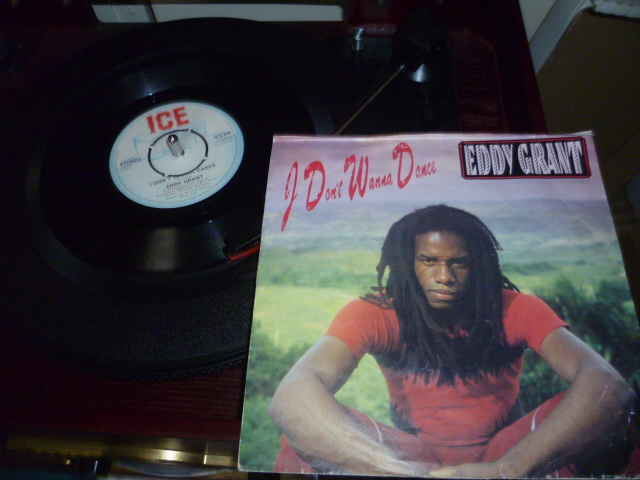
Eddy Grant - I Don't Wanna Dance
Eddy Grant is one of them living music legends. A Reggae superstar, fine fine songwriter, producer, owner of his own label and political activist, the man's like a beast. Grant was the frontman for early Reggae/pop group The Equals in the sixties, and despite a solo career throughout the seventies, it wouldn't be until 1982, where he would get his big smash hit, I Don't Wanna Dance.
It opens up with the chorus over a really chilled and sweet reggae beat embeleshed by some eighties synthy. It follows this standard rhythm throughout, keeping it subtle and not building up for the chorus, letting you just stay with the groove. There's a pretty cool short fuzz guitar solo, reminding me of those in Kevin Ayers' albums. The track trails off with a repeating of the song's title. All in all, it's a short sweet song over a nice chill beat.
For the B side, we get an accapella rendition of I Don't Wanna Dance, which is a bit misleading, as it includes percussion, echoed production. It's more kinda like a dub-lite version to be honest, and it still stands strong as a good track, aided by the shortness of the song, it does work.
Basically, I love Reggae, and I love Eddy Grant, so I also love this. Even if I didn't, I'd still like this, it's just one of those songs that you can't fault. Simplistic yet utterly enjoyable.
Monday, 15 October 2012
Toyah - Thunder In The Mountains
Associated with punk, I never really gave Toyah a chance, even when I heard that she was married to Robert Fripp (one of my guitar idols), but it turns out, she's more like a died-hair loud Kate Bush sort. Good songs, bright hair, and quite an allright voice.
Thunder In The Mountains kicks right off with a groove, and faux-gothic chancing. Toyah's singing kicks right in for the verse, which then builds up to the chorus which is pretty epic rock, over a nice groove. It's very eighties, in style, production, sound and structure, but works well, a solid song. The little faux-gothic flourishes add character onto what could be just a usual Blondie-like pop-punk production. Punk's own Kate Bush.
The second side is Street Addict, and as usual for songs of a similar title, I get the feeling that Toyah is singing about this romanticised view of the underworld. We get a bass line bringing us in, keeping the track minimal and with a haunting sound. Toyah sings over the top, in a reverbed effect, again there's this goth-rock sound, mixed in with a punk and pop sound. The chorus is denser but still keeps it pretty minimal. It's an allright song, just a bit dull compared to the A side.
Well, it's a neat little single for you to pick up and enjoy. It changed my opinion on her, and who knows, it may change yours too!
Thursday, 11 October 2012
Frank Zappa - Broadway The Hard Way
I was unsure about whether I'd write a Zappa review on this blog, because the love and respect I have for the man and his musical vision is so pronounced that it can be hard, ney, impossible, to remove any bias. Oh well...
Picture the scene, it's the late eighties, Frank has assembeled a fresh band of virtuoso musicians and is touring once again, aided by a Synclavier synthesiser (a proper one, not one of those Casio keyboards). The political scene in the US has shifted heavily towards a theocracy, and with more corruption appearing in the news every day, Frank tours, with new material and old, always keeping an ear towards the news, always changing the music to reflect the reality of the time. This is Frank Zappa's farewell tour, this is one of three albums taken from his '88 tour. This is Broadway The hard Way!
Side 1 opens with Elvis Has Left the building, a mock religious theme with a soft-rock rhythm. reflecting southern state country rock. The trck features random and humerous sound effects emphasising it's inherent stupidity. As you can guess, this track is about Elvis residing up there in heaven, and features such a deliberately cheesy melody while lyrically tearing down the cult of Elvis and also absurd religious views. Next, Frank takes us to the Planet Of The Baritone Women, a satirical look at the powersuit wearing women of eighties pop music. This track reflects the unusual Broadway influence which encroached on Zappa's music during his Thing Fish project. Bobby Martin treats us to some fantastic vocal technique in true musical style. It can be seen as an anti-feminist track, but that is to ignore the contrived nature of that pop scene. This idea is followed through with Any Kind Of Pain, which features on the manufactured, powdered, puffed up glamour star, the young blonde who is there to look pretty and do nothing else. Again there is a distinct musical feel to this track, it is painfully eighties, yet Ike Willis' singing really carries it with a sense of soul. It features several Zappa music tropes such as short sections of staccato arps, a totally slick liquid guitar solo, and a band comfortable enough to play around. Frank often said that he thought this was the best, most capable band he'd toured with (despite an ongoing conflict between several members, which forced him to abandon the tour) and the tightness of the playing here really shows why. They are totally at ease, which allows Frank to play an amazing solo, totally at ease. Confinement Loaf, Stupidity, Sex, Drugs, all the Zappa lyrical motiffs make an appearance here, all we're missing out on is poodles!
Side 1 ends with Jesus Thinks your A Jerk, which is Zappa at his most playful, yet also most serious. A child-like southern psuedo-religious rock sound starts the track, describing the sauded activities of those at the top of the Republican party, the corruption and religious extremism which has made the party a very dangerous bunch, which has extra relevance now, with Mitt Romney's rather... discriminatory outlook to middle eastern politics. The playful tune of this track doesn't belittle the subjects covered, infact it helps emphasise the absurdity of the religious right, and the rather simplistic mentality that they possess. The track makes it's first shift, towards kinda lounge jazz whilst talking about guns and the NRA, and the hipocrasy it involves, before returning to the bouncing rhythm and some of the more disturbing lyrics Zappa has sung, the muisc merges into a 'Twilight Zone' section, whilst we're treated to a nice mini-lecture about Pat Robbertson's rather evil nature (I dislike the words good and evil, but really... the guy is fucking hideous!). and we get this lounge-jazz Twilight Zone style thing which reminds me of the music from The Starlight Zone from the first Sonic The Hedgehog game. The track gets rather eighties and uses the 'aspiration pop' cliches whilst talking about how bad it would be if Pat Robbertson got into power. We get this melody to end with, featuring Old Rugged Cross and the old Zappa stalwart, Louie Louie, before the Broadway style ending before the intermission (or changing of sides...). This track is Frank at his most preachey, however he is a beast and hits the nail on the head with every point mentioned. While musically, it lacks the complex hooks of other tracks, it maintains a great sound throughout and manages to tackle a disturbing subject matter with his usual lack of subtlety yet holds on throughout.
Zappa was well known for being at the cutting edge of current affairs, and able to always bring it into his music, though for some reason, Side 2 is the first appearance of a longstanding track, Dikie's Such An Asshole(sincerely Dick, we mean it), a live favourite since the early seventies! Not that it's a bad track by any means. We get some talking to start it off, and an explination of confinement loaf. Dickie's such an Asshole is not a bad song by any means, and features some of the complex runs and musical motiffs found in Zappa's earlier work, but adapted to suit the newer (much larger) band. Anyways it's about Richard Nixon (Tricky Dicky) and his rather controversial use of the FBI and related organisations. Just y'know, it's kinda at odds with the other material since it is not that contemporary(despite the appearance of confinement loaf), and so feels more dated. The guitar solo however is as razor sharp as usual, Zappa showing how to really let loose without being a technical virtuoso. The next track is When The Lie's So Big, another preachy track, yet one that I think really works despite being utterly eighties. Willis' soulful again really plays to the epic grand scope of the song/subject. Critiquing the Republican's and in particular, Pat Robertson, using the impressive brass section to really punctuate the points. This track covers America's transformation into a theocracy and the lies targeted towards the population. It also covers a few different musical ideas using them effectively as the lyrics dictate. Good track.
The preaching continues with Rhymin' Man, using an ol' southern musical twang to describe the Republicans, and the lies and scheming of the conservatives. Total conspiracy fun, whilst ending every point with different musical licks and ideas, allowing the fun of the music to come to the fore, and again show the absurdity of the situation. A nice quotation of The Knack's My Sharona helps keep a sense of rhythm and beat to propel the track towards the conclusion. The next track, Promiscuous describes the Republican's rather unintelligent view of sexuality and STI's such as AIDs, however it's done rather embarassly in this really naff rapping, which clearly lacks the energy of the masters such as NWA and Public Enemy. The idea of a CIA created illness to cull the African population however is thouroughly terrifying and would sound absurd if not backed up by official documents. The album ends with a cover of The Untouchables theme, with added lyrics about, you guessed it, Republicans. In particular their corruption and strange ways of doing things. Again it's one of the weaker tracks on the album but ends it with a listing of the exceptional band members.
It's a good album, about half the length of the CD release (which is a whole different beast and a dense package of so many musical ideas). Many people dislike Frank's late eighties work, but I think it works so well as a resurgence of his political venom which helped make him such a historic figure during the sixties. It's not a MUST HAVE, and by no means his best work, but difinately it's good and solid and has an actual purpose/meaning. A document of it's time for sure.
Monday, 8 October 2012
Twisted Sister - I Am(I'm Me)
Twisted Sister... well known for prettymuch being the extreme arse-end of eighties heavy metal, with drag makeup so thick that even KISS would think twice. It was a deliberate image, to seperate themselves from the prettyboy feel of Motley Crue and Poison, though musically they remain forever locked in the halls of eighties genericness. Though I Wanna Rock, is actually alright.
The A Side, I Am Me(I'm Me) opens up with typical power chord and throbbing rhythm, getting more heavier at the chorus, but it's ultimately weak and un-threatening. Like an old style Andrew WK but without his ironic party themes. there's something soft and Brian Adams-y about the music on this. The solo continues with a very out of tune play on the melody but doesn't help the track at all, Twisted Sister are terrible. When you make Slade seem as threatening of Judas Priest, you know you've messed up.
Talking about the Priest, this single's B-Side, Sin After Sin, takes it's title from their third album (and easily one of the best metal albums ever released), Sin After Sin. Just here we lack the class of Let Us Pray or the sheer anger of Dissident Aggression, it's a live heavy track, and yeah it is heavier than the A Side, but is still ultimately cheesy as camembert. Faux-thrash metal mixed in with eighties arena rock to produce just a very VERY FUCKING ANNOYING track, like, imagine The Damned trying to play Led Zepplin. It's that bad.
Ultimately, Twisted Sister are best forgotten, a guff of anal vapour on the stairway of musical history. It's not a good single, not by a long shot.
Friday, 5 October 2012
Michael Jackson - Black or White
The crowned prince of pop, Michael Jackson has had... let's just say... a little bit of a successful pop career. He's become one of the most famous figures in the world, and his face is perhaps the most easily unidentifiable (for many obvious reasons). Tracks such as Billie Jean, Beat It, Thriller... the list is endless even when we don't include his hits in the fantastic Jackson 5!) In the years before his death, Jackson was plagued with allegations that he was a card carrying member of the Gary Glitter fan club, but this blog is not here to discuss somebody's perverse sex life, it's here to talk about the hypocrisy of releasing a song stating 'It Doesnt' matter if you're black or white' whilst selecting your own skin colour from a Dulux paint chart.
Ok, ok, It's not! I'll just talk about the song. Happy now? Got it.
Side A is Black Or White, starting with some sound effects before locking into the Prince-like groove, a funky beat and Michael comes in singing. It repeats itself, like, it's quite a boring song to be honest. The groove is not enough to carry itself over constant repetitions like a P-Funk groove. We get a bit of a harder electric section and rap by Bill Bottrell, but it's all superficial, and just feels like jumping on the trend. This really is a sign of the times, where jacko had become a parody of himself, and this song really doesn't hold well when compared to tracks like Beat It or Thriller.
Side B is an instrumental version, and to be honest, it just really emphasises how musically boring this track is, and without a proper solid groove, it's even hard to dance to. Nothing more to say really.
This is Michael Jackson trying to take Prince on, but without the intelligence or carisma of the man's music. It comes out as shallow, superficial and just extremely boring. Jacko had achieved such great heights in the eighties, but after you reach the mountain's peak, the only way is down, and Jacko seemed to have banged on a couple of rocks on his way down(musically speaking... though it would explain away his need for surgery!) I would say it's one of Michael's worst songs... but then I remember The Earth Song, and (shudder) Scream, and I think again.
Wednesday, 3 October 2012
That's Jazz!
![]() |
| Miles Davis, one of the biggest inspirations in my life! |
So, yesterday, I was browsing through the music stand at my local Tuesday market, I had already picked up four LPs and just as I was about to pay, I noticed one more box to flick through. The owner (who looked like a combination of Seasick Steve and Worzel Gummage) of the stand said to me in an almost dismissive tone 'That's Jazz!', as if a mid-twenty-something guy wouldn't know what Jazz is. The way he said it was like, it's a forbidden secret, something alchemical, and supernatural. Something you have to know about to like...
Which is pretty absurd, I got into Jazz without knowing anything about it. I didn't know who the stars are, I couldn't tell (or even know of) the difference between Bebop and Cool. Obviously though, as time went on, and my interest in Jazz grew, I've become reasonably knowledgeable about it. I can't list exactly who played in Charlie Parker's band in 1945 for sure, but that isn't that relevant to enjoying the music.
However, what is true is that there is a sense of alchemy to Jazz, in how it draws such base elements together, and creates gold from air. Jazz is dangerous, especially as it became more about personal interpretation, experience and improvisation, 'the moment', it became a right dark world. By the fifties, drugs and Prostitutes were used as payment more than cash, many legends had already set their life on a final crash course, and many would die young. However from this darkness comes the ultimate expression, the way out, the now institutionalised view of the Jazz performer, being at one on the stage, the music is the escape and the raison d'être. Billy Holiday dealt with much trouble in her life, yet propelled the art of singing into such alien territory, the voice as sheer emotion. Charlie Parker, Miles Davis, Eric Dolphy, Chet Baker and so many more were either briefly or long-lasting drug addicts, yet took music beyond what could be expected. Miles Davis himself was a one-man revolution!
![]() |
| Sun Ra took Jazz to the reaches of space, and he never came back down. |
While Jazz did become infiltrated by the commercial sector, and even men like Miles Davis would produce sub-par albums for the cash (these would flitter around during the fifties, but by the sixties and seventies, he was the living embodiment of artistic integrity), many leading figures would still create such earth-shattering works of spirituality. Ornette Coleman's Free Jazz was a quest for a new music, looking back into the history of 'black music' whilst surging forwards with such energy that those who didn't follow through were often left drifting in the cold dark space of irrelevance. Through it, he managed to perfectly secure the sound of the times, the anarchy and chaos of America's racial situation, and the search for a new 'Black Identity'. John Coltrane took his art to further heights, the saxophone becoming almost a direct connection to the spiritual world, the world of pure feeling and emotion, free of earthly baggage. An idea which was surpassed only by Sun Ra, the all loving angel from the planet Saturn, one of the original Moog players, and a conduit to true cosmic energy. His band, the 'Arkestra' were themselves used as a great big instrument by Sun Ra, whose out of this world Jazz would eventually influence the emergence of psychedelic rock.
There is a wide dismissal of Jazz particularly amongst the white middle class (who may perhaps have a Wynton Marsalis or Kenny G CD because it makes them feel oh so cultured because they like 'jazz' with a lowercase j), many comedians will make jokes about Jazz and it's experimental nature, as if it's an embarassing footnote in the history of music. Ultimately though, this comes from the reactionary attitudes of the white elite during the height of the American civil rights movement. The more violent and oppressive the elite got, the more expressive and experimental Jazz got, the darker, edgier and painful the situation, the harsher, more aggresive, experimental Jazz got, to express these feelings. Unfortunately, the cultural baggage was put down and has stayed there. You just know that whenever somebody uses the phrase 'experimental jazz', they haven't listened to any of it.
![]() |
| Billie Holiday, singing with a voice straight from the heart |
Ultimately, my love of Jazz is prettymuch infinite, and I feel like it's one of the 21st century's greatest mistakes that Jazz is being left as this mouldy old music from the past, to be viewed like Bach and Vivaldi. Jazz is true music from the soul, it's influence is around everywhere, and it's feelings of individuality and expression are far more relevent now in our world of corporate and commercial mundanity. In a world where people think that tweeting about their breakfast is the height of individual expression, we need Jazz more than ever. It's powerful stuff, it's beautiful and ugly, dangerous yet loving, free yet oppressive, personal yet impossibly cosmic. Young people should not be discouraged from listening to Jazz, it should be encouraged, and hopefully it can earn it's place as the most pure form of expression around.
Friday, 28 September 2012
Gary Numan - We Are Glass
Electro pop would be forever relegated to the zone of 'geeky post-punk curiosity' without Gary Numan. The man came out of nowhere, took the style and brought it kicking and screaming into the mainstream world, whilst still never leaving his integrity behind. Numan would continue to play around within the music, creating intricate sounds and pieces which are so perfectly balanced that they would shatter like glass if even the slightest sound were changed. So it's kinda right for my first Numan review to be We Are Glass.
The A side it We Are Glass, it takes us in with a repetitive beat, and a cool alien symth sound, with Numan comming right in with the lyrics virtually bouncing around the music. The track has a more energetic and liquid feel compared to Cars, a more standard tune really boosted up by it's synths which add a real energy to it, and along with the galloping rhythm guitars, help propell it forward into the future.
The next is a cover of Erik Satie's Trois Gymnopedies (1st Movement), using the synth to give Satie's trademark dissonant melodies an even more ghostly and haunting feel. This reminds me very much of Mort Garson's early electronica. I'm quite a fan of Gymnopedies (learning it on guitar :D , so this track really speaks to me, and it's just so cool that Numan decided to have it as the B side, like, polar opposite of the first track. It carries such emotion and alienation with it.
So here we have two solid tracks on one solid piece of plastic. A great single from a great songsmith!
Labels:
7'',
80's,
Electronica,
Gary Numan,
pop,
Synth
Monday, 24 September 2012
Fine young Cannibals - Johnny Come Home
Born out of Two Tone ska legends, The Beat, Fine Young Cannibals (or FYC if you're lazy like me) managed to combine rock, ska and soul together to form a unique sound which fortunately proved successful. Their music has a very down to earth and real feel, providing a true example of British life, everyday life. Johnny Come Home was FYC's debut single, and a suprise hit. It's also a damn good song.
The A side, Johnny Come Home, revolves around a guy running away from home to start a new life, but things don't always turn out well. A bouncy beat and a jazzy trumpet solo take us into the track, and Gift's voice takes us in. The chorus is quite early in the song, it's a very moody yet bouncy soul-like chorus. The verses are very ska, showing a connection to The Beat, and we get treated to a jazz soloette before returning to the verse. Like I said, damn good song.
The B side is called Good Times And Bad, a running drum beat takes us into the track, a nice rhythm, with voice samples over the top, combining dub stylings with a pop-rock sensibility, similar to what Fun Boy Three did on Funarama. It's got a good head moving beat, yet still melancholic. Kinda out of place, yet working, some violin appears towards the end, giving it an epic feel before it fades to silence.
As you can guess, this is a remarkable single and much recommended. I got it in a charity shop in a bundle of 10 singles for £5, so it's proof that you've gotta keep your eyes peeled!
Wednesday, 19 September 2012
COMPILATION SPECIAL #2!
ok, so here's three more groovy compilation albums, today with a more electic taste. I think we can say that these compilation specials occur when I wake up with a hangover! I need proper focus for a regular review, but these are short and sweet.
Today's involve Daevid Allen, Funkadelic and Miles Davis:
Daevid Allen: The Man From Gong The best Of Daevid Allen
Daevid Allen is widely regarded as a musical genius, and rightfully so. From Soft Machine to Gong to a successful solo career and collaborations with Acid Mothers Temple, Daevid has never stopped experimenting and playing with his own unique world of music. This little CD serves as an excellent introduction to the man, with highlight tracks such as Floatin' Anarchy (with Planet Gong), Why Do We Treat Ourselves Like We Do, and the post-punk excitement of Pearls and Bananareggae, you'll get a glimpse at an eccentric genius from another planet. His discography is vast, and you should all dive in!
Funkadelic: You Got The Funk We Got The Funk
2 CDs of pure Funkadelic, what can go wrong? Featuring trademark tracks One Nation Under A Groove, Electric Spanking Of War Babies and Maggot Brain, you know this disc is for true funksters only. George Clinton propelled Funk into a new territory during funkadelic's early albums in the seventies, and this sampler shows us the more refined P-Funk sound of the second half of that decade, grooves in total control, and an excellent tightness in the playing, whilst still staying true to the mothership. Also included are two instrumental versions of previously mentioned tracks, which are just perfect for sampling or backing tracks for jams. A good introduction to these crazy mothas.
Miles Davis: The Very Best Of Miles Davis The Warner Bros. Sessions 1985 - 1991
It's a widely held (and widely inaccurate) opinion, that Miles Davis' eighties work is cold, clinical and lacks the emotion and skill of his previous work. This is a total fallacy. Here we have a true artist going against the contemporary jazz scene (which became dominated by the 'mouldy figs' such as Wynton Marsalis, during the eighties, and still stays true to this day) and carrying on experimenting. Hip Hop production techniques brought Davis down to a real street level, enigmatic playing brought a new unease to his music, and his rendition of Time After Time turns a good pop song into a truely emotive jazz standard, and one of my favourite recordings of all time. Pure emotion that literally brings me to tears everytime I hear it. Tracks such as Chocolate Chip, Mystery, Amandla and Summertime show how Miles took jazz in new and exciting directions whilst also creating new interpretations of classic standards. A great introduction to a much misunderstood period of a great musician.
So here you go, three good compilation albums which can expand your musical understanding. The Miles Davis disc (the first of his I got) had such a profound influence on me as a young guitarist that I still try to model my playing on his horn blowing. I'd say get em all.
Friday, 14 September 2012
COMPILATION SPECIAL!
Ok, this one is different. Compilation albums don't really require the depth of a real review, since they are literally just a collection of songs, and unless specially mixed/edited to form a new album (such as Hawkwind's Roadhawks or Bowie's All Saints) treat each component as an individual. So here's three compilation albums to enjoy!
Bob Marley & The Wailers - Legend
More people know of this album than any of Marley's albums proper. We get all the classic tracks here, No Woman no Cry(this live version is outstanding), Buffalo Soldier, I Shot The Sheriff etc, etc. As you can expect, these are all great songs, and this is a perfect introduction into the world of Tuff Gong. Chilled reggae grooves by a man who has something to say, a true icon and a true legend. The disc's title says it all. A total MUST HAVE!
Lee Perry - Reggae Genius 20 Upsetter Classics
It'd always be hard to come up with a good compilation for this man, producing so many reggae classics and introducing the world to dub, Lee 'Scratch' Perry is a true genius. Highlights include The Return Of Django and I Chase The Devil, this album focuses far more on his straight reggae side. We get some lovely phased effects on the tracks but nothing as bizzare as his dub work, there's no Super Ape Inna Jungle, here, which to be honest is a shame, but Disco Devil is still great. The fail to include Perry's dub works make this a difficult compilation to recommend. The music here is all outstanding, but it's just an incomplete compilation.
Madness - It's... Madness Too
As a previous single review may have hinted at, I am a massive Madness fan, always have been and always will be. This disk here in my hand is one I have owned since I was about seven years old! Thankfully it is not the standard 'greatest hits' style of compilation, missing out on tracks like Baggy Trousers and House Of Fun, instead we get some solid singles, and their great B-Sides. Stand out tracks are... man, these are all stand out tracks! Cardiac Arrest deserves special recognition though, a chart topping hit about a guy having a heart attack. Awesome. Anyways, this is a good collection of great songs, it doesn't contain all of Madness' best, but would still be a good introduction to the nutty boys.
Three compilation albums reviewed for the price of one!
This is also proof that I can write an album review in under 2,000 words.
Labels:
Bob Marley,
CD,
Compilation,
Lee Perry,
LP,
Madness,
Reggae,
ska
Monday, 10 September 2012
Grace Jones - Slave to The Rhythm
Singer, Model, Actress, Gay Icon(I don't know either!?) Grace Jones is a pretty big figure, and an example of what was good about eighties fashion, even her amazonian beauty graced Roger Moore's last bond movie as the unforgettable Mayday. Her music is on the dance spectrum of all things, however is decent enough to listen on it's own without being in a club!(unlike modern dance music and dubstep, but I'll moan about that another time)
Track 1 starts with a nice chord sequence followed by Jones' deep voice, Slave To The Rhythm, before we get to a nice funk beat, with her singing pretty seductive. The chorus is pretty, I don't know, epic? is moves well with the song, and has an uplifting kinda density to it, which contrasts yet compliments the verses. Originally, this track was written for Frankie Goes To Hollywood, and is stylistically similar. All I can say though is that Grace Jones' voice is utterly powerful, and the music is electro-funky. It's a really good song, and you should give it a check.
The B Side is Annihilated Rhythm, starting with a clicking beat and just grooving along motorik style, the bass comes in, and we get some spoken word sections, and a chorus of one word, SLAVE! As a dance track, it carries on this beat and rhythm, as is pretty cool to listen to, like great background music.
So yeah, a good little single, and I'd say give it a try!
Thursday, 6 September 2012
Robin Scott's M - Pop Muzik 1989 Remix
At the turn of the eighties, synthpop was taking over. David Bowie's Berlin Trilogy had lit the paper, and the subsequent explosion of electronic groups would create a trend and style which continues to this day. Synthesisers allowed music to become impersonal, allowing the creation of truly synthetic music. A beat, a groove that people could dance to, and that became all that matters (something Bowie himself would revisit in Let's Dance). In 1979, Robin Scott's M released Pop Muzik, which was a chart smash, in 1989, they would release a remix of it, let's see how both compare, as the A side is the remix, and the B Side is the original!
Fanfare opens up to the 1989 Pop Muzik remix, followed by it's trademark beat and chorus, taking us into the rap-like voice. The beat stays the same throughout the track, we get slight moments of synth plodding and twinkling and processed backing vocals. The track is definitely danceable, but that seems to really be it. Also the beat sounds very much like that of the Ghostbusters theme. The lead singing shows an almost comical lack of caring, it's just some fun.
Side B is the original Pop Muzik, opening up with a digital fanfare as opposed to the remix's one. The beat is more synthetic and synthy, the vocals exactly the same, the beat the same, just the track sounds flatter, due to the more earlier synth sounds. Again it's danceable and that's really it. Why they included this as the B side makes no sense, as very little has changed between the two versions.
So, All in all, a dance track and nothing more. I can imagine it was fun to bounce to back in it's day, but lacks the mega-compressed bass of modern dance tracks, so I doubt it would work well in today's nightclubs, unless it had megabass and the same dirty synth chords which're used on every track. In short, don't get it, it's dull.
Subscribe to:
Posts (Atom)